
 Support
Support triage coordinator
Classifies requests, drafts replies, retrieves approved answers, routes edge cases, and updates the ticket system.
 Zendesk
 Gmail
Gmail Docs
Docs- Human gate
- Approves sensitive replies
- Primary metric
- Response time
Every role is configured after the audit. The roster is a menu of workflow patterns, not a promise that one generic bot fits every business.
These examples show what can be built once the workflow, data, approvals, and value case are clear.
SupportClassifies requests, drafts replies, retrieves approved answers, routes edge cases, and updates the ticket system.
ZendeskGmailDocs Sales
SalesScores inbound leads, enriches context, drafts follow-up, updates the CRM, and alerts the deal owner.
 HubSpot
 Calendar
 Email
Email Operations
Collects updates, checks anomalies, compiles summaries, and prepares decision-ready weekly reports.
 Sheets
 Slack
Slack Looker
 Knowledge
Retrieves approved company context, keeps answers cited, and refuses to answer outside the knowledge base.
 Notion
 Drive
Drive Confluence
 Operations
Intakes documents, extracts fields, classifies records, flags missing data, and prepares validation queues.
Drive OCR
OCR Database
 Admin
AdminSchedules handoffs, sends reminders, follows up on approvals, and keeps operational tasks from stalling.
CalendarSlackEmail Knowledge
Builds competitor briefs, market scans, and source-backed summaries for sales, strategy, and delivery teams.
 WebNotionSheets
 Sales
SalesAnswers visitor questions from approved site content, qualifies intent, and routes serious buyers to the audit flow.
 Website
 SupabaseEmail
Every role in the roster runs on the same operating contract, so the channel changes but the owner, rules, and approval gates never do.
Calls get answered, routed, and logged with natural conversation. Anything needing judgment escalates to a human before promises are made.


The difference is the operating contract: who owns it, what it can touch, what it cannot do, what it must log, and where a human takes over.
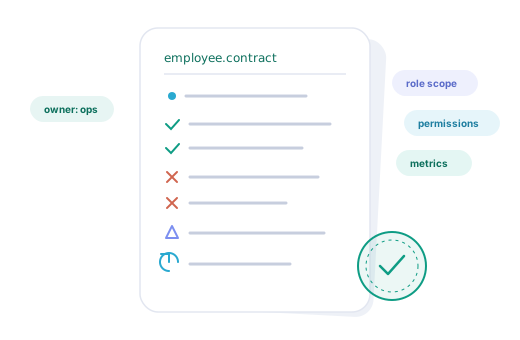
Define the workflow, trigger, inputs, outputs, integrations, allowed actions, exclusions, and success metrics.
Connect tools, approved context, prompts, logging, approval gates, and evaluation checks into one bounded system.
Launch in a limited production window, train the team, monitor outputs, and move into Managed AI Ops.
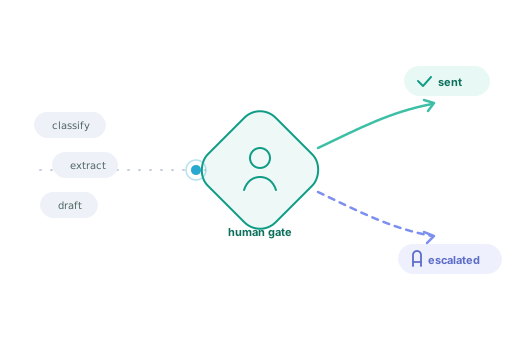
If a workflow cannot be evaluated, monitored, escalated, or rolled back, Epoches does not deploy it as an autonomous AI employee.
The workflow owner, purpose, user group, and escalation contact are defined before implementation.
Each employee gets written permissions, forbidden actions, data boundaries, and tool access limits.
Sensitive replies, external sends, financial changes, and edge cases are routed to human approval.
Happy paths, edge cases, hallucination checks, latency, cost, permissions, and rollback are tested.
Start with the audit. We will identify the workflow, score the opportunity, and recommend the first AI employee only if it can be governed and measured.